Deep-dive into the architectures, protocols, and security frameworks that underpin our converged IT/OT network platform.
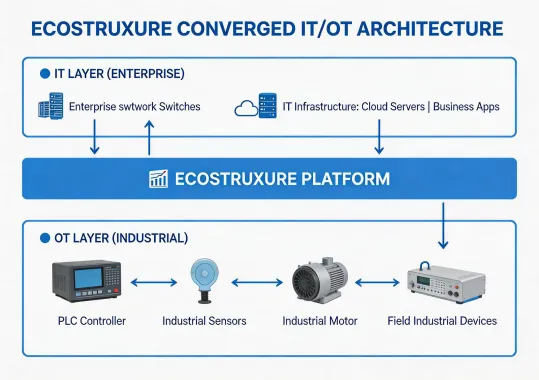
EcoStruxure is Schneider Electric's open, interoperable IoT-enabled architecture that unifies connected products, edge control, and cloud analytics into a single management domain.
At the network layer, EcoStruxure bridges traditional enterprise LAN management (SNMP, Netflow) with industrial protocols (PROFINET, EtherNet/IP, Modbus TCP) — enabling a unified NOC view across both IT and OT traffic.
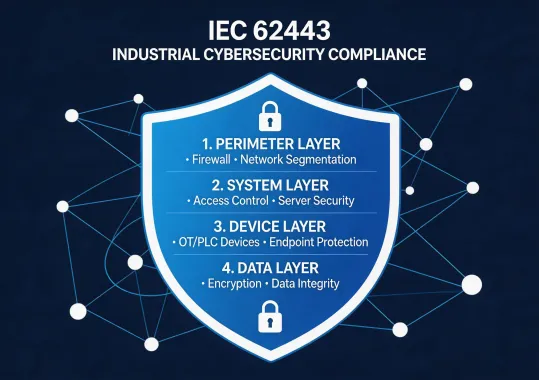
Every Schneider Electric network device is engineered from the ground up to meet IEC 62443 Security Level 2, with optional SL3 hardening for critical infrastructure deployments.
Our defense-in-depth approach spans hardware root of trust, secure boot chain, encrypted configuration storage, 802.1X port authentication, and role-based access control with RADIUS/TACACS+ integration.
TPM 2.0 chip validates firmware integrity at every boot cycle.
VLAN-based isolation with MAC/IP binding prevents lateral movement across network zones.
AES-256 encrypted startup configs with certificate-based remote access.
Technologies we are deploying today to prepare your network for the demands of tomorrow.
IEEE 802.1 TSN profiles (802.1AS, 802.1Qbv, 802.1CB) enable deterministic sub-microsecond latency for real-time industrial control, motion synchronization, and audio/video streaming on a shared Ethernet backbone.
Embedded ML inference engines on our edge gateways process sensor data locally — detecting anomalies, predicting failures, and optimizing energy consumption without cloud round-trips. Supports ONNX and TensorFlow Lite models.
IEEE 802.3az Low Power Idle combined with our proprietary adaptive port-speed technology reduces switch power consumption by 40% during low-traffic periods — validated across 10/100/1G/10G interfaces.
Type 4 PoE delivering up to 90W per port powers PTZ cameras, Wi-Fi 6E APs, thin clients, and LED luminaires on a single Cat6A cable — simplifying installation and reducing copper infrastructure costs.
Dual-stack support enables simultaneous industrial protocol traffic (PROFINET, EtherNet/IP, Modbus TCP) and enterprise traffic (HTTP, SNMP) on a single managed switch — reducing hardware footprint.
OpenFlow 1.3 support and REST-based northbound APIs enable programmable network fabrics. Integrate with cloud orchestration tools for automated provisioning and dynamic QoS policy enforcement.
Every networking platform operates within defined performance envelopes. Understanding these boundaries ensures correct product selection for your specific deployment.
Industrial switches rated for -40°C to +75°C operate at full wire-speed within -10°C to +60°C. At temperature extremes (below -25°C or above +65°C), switching fabric throughput may derate by up to 15% due to thermal throttling of the ASIC. Deployments in sustained extreme ambient conditions (desert substations, arctic pipeline monitoring) should factor this derating into capacity planning.
While our switches support IEEE 802.1AS, 802.1Qbv, and 802.1CB, TSN interoperability with third-party endpoints depends on the specific profile implementation of each device. As of 2025, there is no universal TSN conformance test suite — meaning lab validation against your specific PLC/drive/sensor ecosystem is required before production deployment. We provide a dedicated TSN interoperability lab for customer testing.
Edge gateways support ONNX and TensorFlow Lite inference, but model complexity is bounded by the on-device NPU capacity (currently 4 TOPS). Models exceeding 50 MB or requiring >2 GB RAM should be executed on dedicated edge servers rather than gateway devices. Complex deep learning workloads (image classification, NLP) remain better suited to server-class edge computing.
A 48-port 802.3bt switch provides a total PoE budget of 1,440W (Type 4). If all 48 ports draw maximum 90W simultaneously, the budget is exceeded — requiring either load-shedding priority configuration or additional power supplies. Typical deployments see 30-40% average port utilization, but high-density PTZ camera installations must be modeled for peak simultaneous draw.
Informed infrastructure decisions require understanding the engineering trade-offs inherent in each architecture choice.
A single-vendor approach (such as Schneider Electric EcoStruxure end-to-end) provides a unified management plane, single point of support accountability, and pre-validated interoperability — reducing integration risk and accelerating deployment.
Conversely, open and disaggregated networking (OpenConfig, SONiC on white-box switches) avoids vendor lock-in, enables best-of-breed component selection, and can lower hardware costs by 30-40% through commodity switching silicon. However, integration testing burden shifts to the operator, and multi-vendor support contracts add complexity.
Our position: We support both models. EcoStruxure offers REST APIs and OpenFlow 1.3 compatibility, allowing customers to integrate third-party tools while retaining unified visibility. The right choice depends on your team's operational maturity and total cost of ownership tolerance.
Traditional on-premises network core equipment provides full control over data sovereignty, deterministic latency for voice/data, and proven reliability for mission-critical SCADA and industrial control traffic. Latency is bounded and predictable — critical when sub-millisecond response times are non-negotiable.
Cloud-native core networks (NFV/SDN) offer elastic scaling, faster feature deployment cycles, and reduced capital expenditure through shared infrastructure. Operators running 5G SA cores increasingly adopt containerized network functions for agility. The trade-off is dependence on WAN connectivity and potential latency variability under load.
Our position: For OT-heavy environments (manufacturing, utilities), we recommend on-premises core with cloud-based analytics overlay. For enterprise campus and multi-site SD-WAN deployments, cloud-native orchestration delivers faster ROI. Hybrid architectures are increasingly the pragmatic middle ground.
Deep-dive specifications, comparison charts, and deployment guides authored by our engineering team.
Request Technical Documentation